
.png)


For nearly 30 years, Home Depot had relied on its legacy store selling system to handle increasingly complex customer purchasing experiences. This system had been cobbled together over time with little to no design thinking at its core, resulting in a fragmented ecosystem of disparate selling platforms, siloed inventory catalogs, delayed delivery networks, and outdated data repositories.
Multiple systems were required to sell products across catalogs (ex: a customer who wants to purchase plywood, rent power tools, and buy appliances would have to visit multiple departments and place separate orders for each). In the event a customer needed to return an item - especially a bulky item like an appliance - the process would generally take hours or days to complete and was a top complaint point among associates and customers alike.
Previous attempts to replace these systems had failed, leaving the organization with growing technical debt and limited confidence that modernization was achievable at scale.


-
Fragmented tools across departments
-
Non-linear workflows
-
Heavy reliance on institutional knowledge
-
Slow onboarding for new associates
-
Friction during customer interactions
"I should be able to just take a customer's order and sell it without having to stop and use another program to get the info I need."
-
Unexpected inventory shortages
-
Painful purchases, returns, and refunds
-
Confusing or non-existent order communication
-
Unreliable delivery experiences
-
Unclear purchase documentation
"Your website said this item was in stock at my local store but when I got here, you didn't have it. I'll get it from Lowe's instead."
-
Sales efficiency & performance
-
Consistency of execution
-
Associate productivity
-
Platform scalability
-
Customer retention
"The fact that people are walking out of our stores angry and empty handed is a wake up call. We can do better."
Given the scope and complexity of the problem, solving for it required more than simply redesigning an interface. It required rethinking how consultative selling operated as an end-to-end journey. My role was to lead experience strategy and design efforts to replace the legacy environment with a guided platform aligned to associate workflows and enterprise business goals. It was estimated that this problem was costing Home Depot approximately $132 million annually, so in addition to solving for associate and customer pain points, the business set strategic goals to close that financial gap and increase store sales year over year.
One of the most important investments made during the program was research.
Rather than designing from assumptions, we committed to understanding how associates actually worked inside stores.
Research activities spanned multiple states and regions, each with their particular importance to Home Depot's business strategy.
Research methods varied based on project goals and included:
-
Contextual inquiry
-
Store observations
-
Associate interviews
-
Workflow analysis
-
Journey mapping
-
Service blueprinting
-
Concept validation
-
Iterative design feedback sessions
By the time Order Up reached national deployment, the team had conducted nearly 500 discovery sessions involving approximately 2,000 associates across more than 30 stores.
These efforts helped reveal not only usability challenges, but also operational dependencies that influenced fulfillment, delivery, inventory management, customer service, and returns processes. Understanding these workflows became foundational to many of the experience decisions that followed.
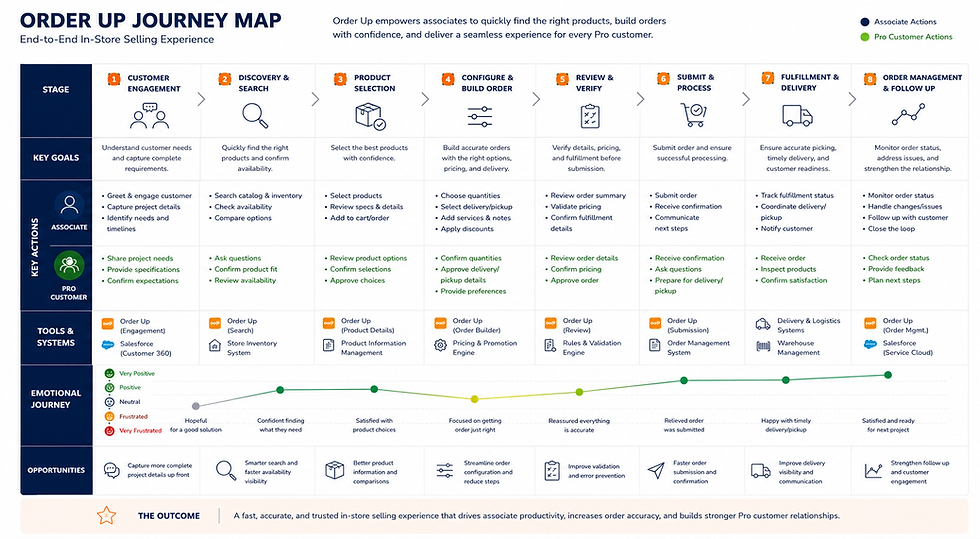
Note: Images are representative and do not contain real project information.
My approach centers on a people-first philosophy: designing platforms that support the real workflows, decisions, and pressures faced by the individuals who use them every day.
Whether those users are store associates assisting customers, professional contractors managing complex projects, or operational teams coordinating logistics, the goal is the same... reduce friction, increase clarity, and enable people to do their best work.
To best structure experience work for my team, I led the implementation of a journey-driven framework inspired by TheyDo's journey management model. This approach connected day-to-day workflows with broader business strategy and OKRs through three layers:
By structuring work this way, design decisions remained grounded in the real needs of the associates using the system while ensuring that every effort contributes to measurable business outcomes. Designers knew exactly what they owned, where their designs fit, and how their work generated outcomes directly connected to the top strategic goals set by the business. It also allowed leadership teams to prioritize investments based on measurable business outcomes rather than isolated feature requests. The result was a shared framework that helped our teams:
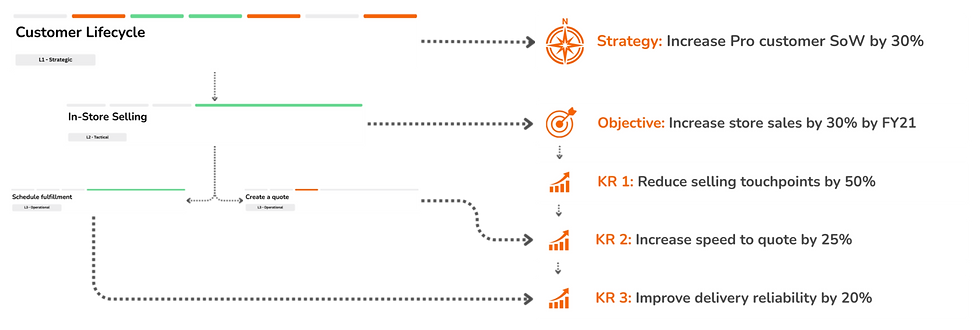
Note: Images are representative and do not contain real project or company information.
-
Align roadmap decisions with strategic goals
-
Prioritize work based on real user impact
-
Reduce fragmentation across tools and departments
-
Connect experience improvements directly to organizational success
As the Senior UX Designer and UX lead within a balanced product team, I helped guide the experience strategy, research, design, testing, and stakeholder alignment efforts that ultimately led to the successful rollout of Order Up across more than 2,200 stores and a user population exceeding 380,000 associates. Over four years, I partnered closely with product and engineering leadership to define experience direction, establish scalable UX frameworks, drive research initiatives, mentor designers, and support the organizational change management efforts required to transition thousands of associates from legacy workflows to a modern enterprise platform.
To maintain alignment across disciplines, I facilitated recurring weekly working sessions with product and engineering partners focused on roadmap visibility, workflow clarification, dependency management, and delivery planning. For larger cross-functional initiatives involving external stakeholder groups, I also led alignment workshops designed to surface competing priorities, clarify operational requirements, and establish shared decision-making frameworks early in the process.
Prioritization and roadmap management were handled collaboratively alongside product leadership using structured decision-making exercises such as impact-versus-effort (2x2) prioritization models, paired with ongoing backlog refinement and delivery coordination through Jira and related pipeline management tools. My role in this process was to ensure UX considerations remained integrated into prioritization discussions while balancing user outcomes, technical constraints, operational realities, and business objectives.
In addition to project leadership responsibilities, I coached and mentored several junior designers throughout the lifecycle of multiple initiatives. This included both tactical design guidance and broader workflow/process mentorship. I regularly provided support on interaction design, systems thinking, design system utilization, and UX tooling, while also helping designers improve how they structured work, organized deliverables, and approached complex problem spaces using scalable frameworks and process models.
Order Up was created to address a growing challenge within Home Depot's selling ecosystem. Associates responsible for selling complex products often navigated multiple disconnected systems to complete a single customer transaction. Quoting, fulfillment scheduling, delivery management, returns processing, and order tracking frequently occurred across separate applications, each with its own workflows, training requirements, and operational limitations.
The resulting experience created friction for associates, slowed customer interactions, and increased the likelihood of lost sales opportunities.
Leadership established three primary objectives:
-
Recover revenue lost through fragmented selling experiences
-
Consolidate multiple legacy systems into a scalable enterprise platform
-
Reduce the time and effort required to quote and sell products
While initially focused on Pro customers, the long-term vision expanded to support selling experiences across the broader organization.
My role extended well beyond interface design. As the UX lead embedded within a balanced product team, I was responsible for aligning customer needs, business objectives, and technical realities into a shared vision that could guide product development over multiple years.
My responsibilities included:
-
Experience strategy
-
Research planning and execution
-
Persona development
-
Hypothesis generation and prioritization
-
Journey mapping
-
Service blueprint creation
-
Design direction
-
Usability testing
-
Feedback synthesis
-
Stakeholder alignment workshops
-
Design reviews
-
Executive presentations
I partnered closely with product and engineering leadership through a "three-legged stool" model that emphasized shared ownership and collaborative decision-making.

As the platform grew in scope, maintaining alignment became increasingly important. To guide decisions consistently across teams, we adopted two main principles that influenced both design and delivery.
1. Design for 'Day One' Associates
One of our primary goals was minimizing training requirements. We regularly challenged ourselves to design experiences that could be successfully used by associates with little or no prior exposure to the platform. This continuously pushed us toward simpler workflows, clearer information architecture, and more intuitive interactions.
Rather than pursuing perfection, we prioritized learning. Rapid experimentation allowed us to identify weak concepts early, gather feedback quickly, and iterate before significant engineering investment occurred.
2. Fail Early and Fail Often
Strategic Journeys
Enterprise initiatives tied directly to company objectives and OKRs, such as consultative selling, pro customer lifecycle management, and associate enablement.
Tactical Journeys
The major phases within those initiatives: discovery, planning, configuration, fulfillment, and follow-up.
Operational Workflows
The systems, tools, features, and interactions associates rely on in their daily work.

Note: Images are representative and do not contain real project or company information.
Large-scale transformation programs create an endless supply of competing priorities. To maintain focus, our team relied on three primary decision criteria:
Was the decision supported by research findings and user feedback?
User Evidence
Did the work directly support established OKRs?
Alignment to Objectives
Did the expected outcome justify the investment required?
Value vs. Effort
This framework created a consistent decision-making process that allowed product, engineering, and UX to remain aligned throughout development. We also had an executive steering committee available for any
Escalation to executive leadership was rarely required because decisions were typically grounded in shared evidence and clearly defined objectives.
Launching Order Up was certainly challenging from a design and development aspect. Another major challenge that we anticipated (but still somehow seemed surprised with at times) was change management. Achieving adoption required hundreds of thousands of associates transitioning away from systems they had used for years. What could possibly be difficult about that, right?
At initial launch, adoption rates ranged between 18% and 20%, which aligned with expectations for a change of this scale. However, our predictions for increased adoption seemed to stagnate, so we got to work with understanding why. We implemented a real-time feedback channel by connecting Medallia to Slack. Associates could submit issues, screenshots, questions, and suggestions directly to the product team who could then take real issues directly to the team for discussion and iteration.
As associates began seeing their feedback influence design decisions, sentiment gradually shifted from predominantly negative feedback toward neutral and eventually positive engagement. The visibility and responsiveness of this process became a critical factor in improving adoption and trust, and we watched our adoption numbers begin to improve. We added a success measuring mechanism via System Usability Scale (SUS) and within 18 months of initial launch, we saw a score improvement of 36% (from 61 to 83).
Order Up successfully replaced the legacy systems it was designed to retire and became the primary selling platform used across Home Depot stores nationwide. Perhaps most importantly, the platform established a scalable foundation for future enhancements that would have been difficult or impossible within the legacy environment.
The most significant challenge of the initiative was not user adoption, research, or organizational alignment; It was architecture. Prior to my involvement, the platform had been divided into three major domains: Selling, Delivery, and Order Management. While this structure simplified work allocation across teams, it also introduced three separate codebases and three separate design systems. As the platform expanded, maintaining consistency became increasingly difficult.
I repeatedly raised concerns regarding the long-term impact of this approach and led conversations with leadership around the risks associated with fragmented systems. Using internal examples and industry case studies, I demonstrated how divergent design and development environments create operational friction, inconsistent experiences, and mounting technical debt.
While we successfully advocated for consolidation into a single design system, engineering leadership determined that merging the underlying repositories represented too much organizational risk. The result was a successful launch accompanied by substantial design and technical debt that continues to influence the platform today.
Looking back, this experience reinforced an important leadership lesson: Experience consistency is not simply a design problem. It is an organizational and architectural decision.
If given the opportunity to approach the initiative again, I would focus much earlier on aligning architectural decisions with long-term experience goals. Addressing those risks sooner would have reduced significant work debt and allowed future teams to spend more time innovating rather than reconciling inconsistencies.
